📌 Data Science vs. Machine Learning
Data Science and Machine Learning (ML) are closely related fields, but they have different purposes:
- Data Science: Focuses on collecting, cleaning, analyzing, and interpreting data to extract useful insights and support decision-making.
- Machine Learning: Focuses on developing algorithms that learn patterns from data and use them to make predictions or decisions.
Relationship Between Artificial Intelligence, Machine Learning, Deep Learning, and Data Science
To understand how these domains interconnect, it is helpful to look at their hierarchical relationship:
- Data Science uses Machine Learning as one of its techniques[cite: 2].
- Machine Learning is a subfield and core part of Artificial Intelligence[cite: 2].
- Data Science also includes statistics, data visualization, and data engineering.
- Machine Learning focuses mainly on learning patterns and building predictive models[cite: 4].
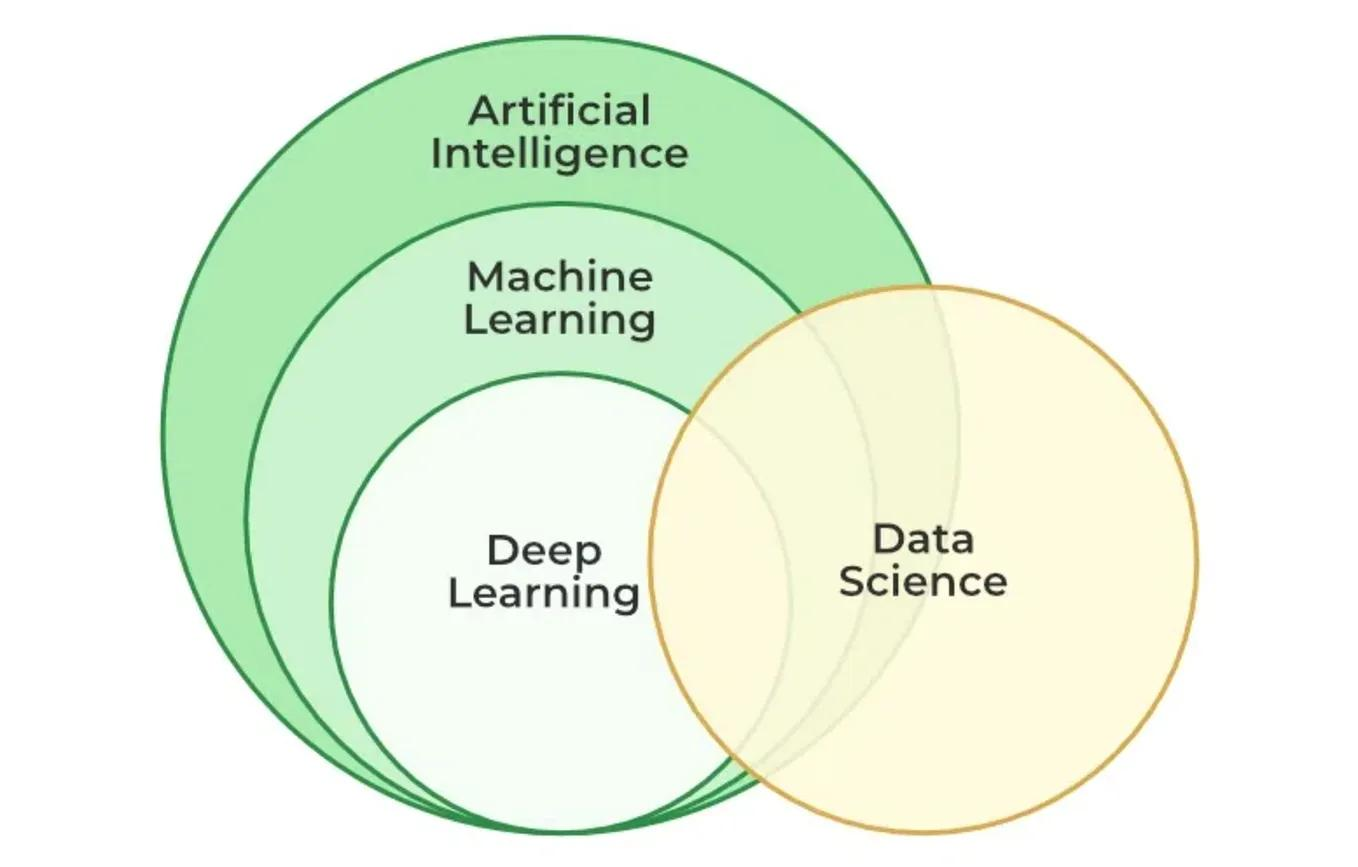
Figure: Hierarchical relationship between Artificial Intelligence, Machine Learning, Deep Learning, and Data Science[cite: 2]
1. Key Differences Matrix
A tabular breakdown comparing the fundamentals, scopes, tools, and outputs of Data Science versus Machine Learning.
| Basis | Data Science | Machine Learning |
|---|---|---|
| Meaning | Extracting insights from data | Teaching computers to learn from data |
| Main goal | Understand data and solve problems | Make predictions and automate decisions |
| Scope | Broad field | Subfield of AI |
| Focus | Data analysis and interpretation | Model building and prediction |
| Techniques | Statistics, visualization, SQL, Python | Regression, classification, clustering, neural networks |
| Programming | Python, R, SQL | Python, R |
| Tools | Pandas, NumPy, Tableau, Power BI | Scikit-learn, TensorFlow, PyTorch |
| Output | Reports, dashboards, insights | Trained predictive models |
| Applications | Business analytics, sales analysis | Fraud detection, recommendations, image recognition |
2. Deep Dive: Data Science
Data Science is the process of extracting meaningful information from structured and unstructured data.
Example: An online shopping company wants to understand customer purchasing behavior.
Example: An online shopping company wants to understand customer purchasing behavior.
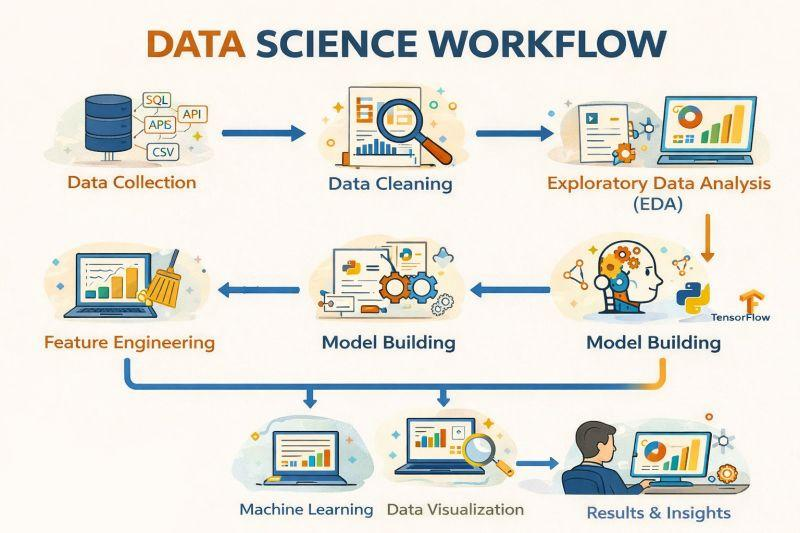
Figure: End-to-end Data Science Workflow Architecture[cite: 3]
Workflow of a Data Scientist:
- Collects customer data[cite: 3].
- Cleans and organizes data[cite: 3].
- Analyzes customer behavior (Exploratory Data Analysis / EDA)[cite: 3].
- Creates graphs and reports[cite: 3].
- Identifies popular products.
- Helps the company make better business decisions.
Popular Data Science Tools:
- Python
- R
- SQL
- Pandas
- NumPy
- Power BI
- Tableau
3. Deep Dive: Machine Learning
Machine Learning is a branch of Artificial Intelligence that allows computers to learn patterns from data and make predictions without being explicitly programmed for every situation.
Example: YouTube recommends videos based on your viewing history.
Example: YouTube recommends videos based on your viewing history.
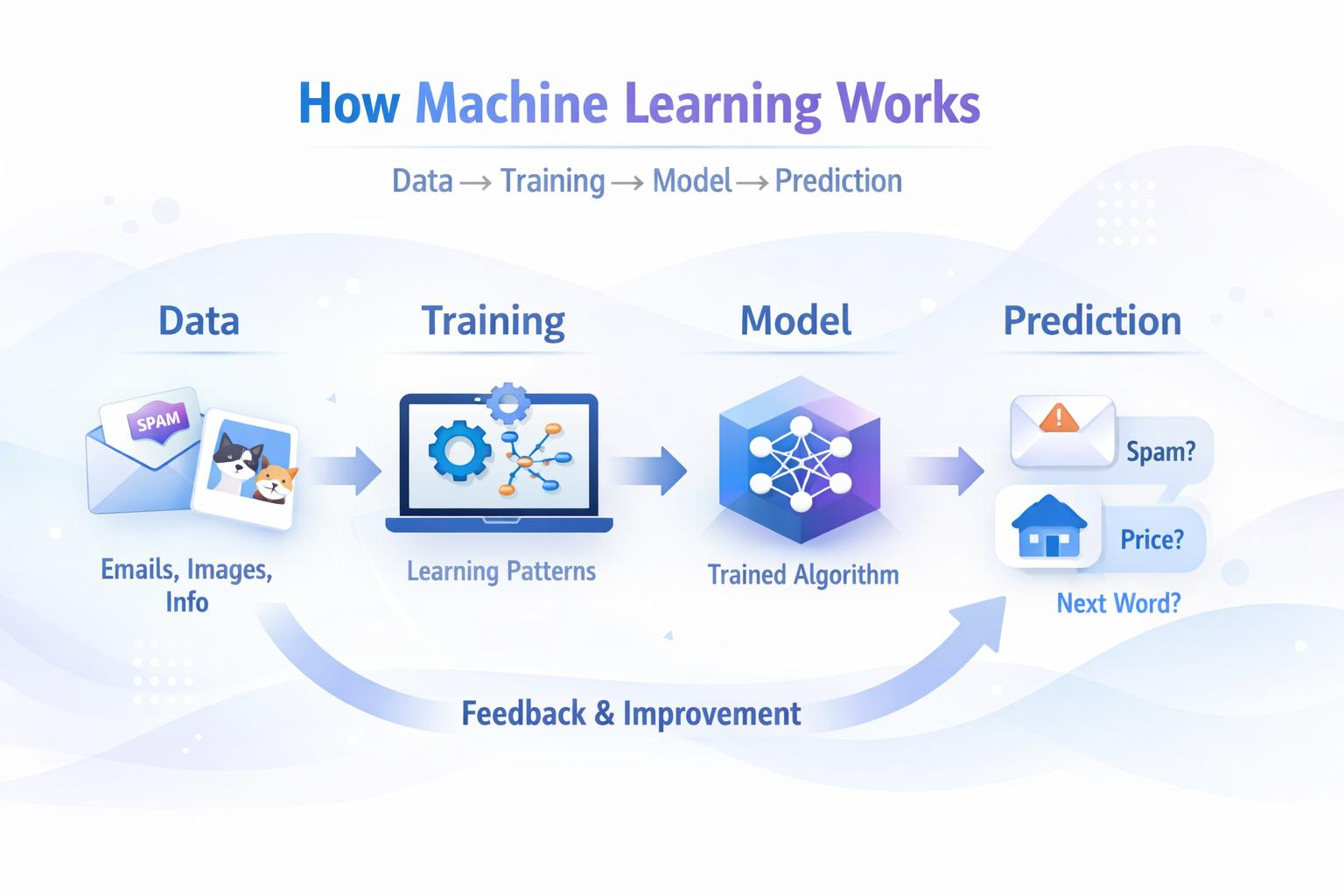
Figure: Core Machine Learning Workflow and Training Pipeline[cite: 4]
Workflow of a Machine Learning Engineer:
- Collects training data (Emails, Images, Info)[cite: 4].
- Selects an ML algorithm to learn patterns[cite: 4].
- Trains the model[cite: 4].
- Tests its accuracy and generates trained algorithms[cite: 4].
- Improves the model through feedback loops[cite: 4].
- Uses the model to predict outcomes (Spam detection, Pricing, Next Word)[cite: 4].
Popular Machine Learning Algorithms:
- Linear Regression
- Logistic Regression
- Decision Trees
- Random Forest
- K-Nearest Neighbors (KNN)
- Support Vector Machine (SVM)
- Neural Networks
4. Real-World Applications Comparison
Comparing typical business domains and automated tasks across both disciplines.
| Data Science Applications | Machine Learning Applications |
|---|---|
| Sales analysis | Sales prediction |
| Customer behavior analysis | Product recommendations |
| Business reporting | Fraud detection |
| Website traffic analysis | Spam detection |
| Market research | Face recognition |
| Financial analysis | Stock price prediction |
6. Which Should You Learn First? (Learning Roadmap)
My recommendation: If you are a beginner, start with Data Science fundamentals and then learn Machine Learning.
Suggested Learning Roadmap:
- Python Programming: Variables, loops, functions, OOP.
- Mathematics and Statistics: Probability, statistics, linear algebra.
- Data Analysis: NumPy, Pandas, Matplotlib.
- SQL and Data Visualization: SQL, Power BI, Tableau.
- Machine Learning: Regression, classification, clustering.
- Deep Learning: Neural networks, TensorFlow, PyTorch.
- Real-world Projects: House price prediction, sales forecasting, spam detection.
Final Conclusion Summary
Data Science helps you understand what happened and why.
Machine Learning helps computers learn from data to predict what might happen next.

Both are valuable career paths, and learning both can open opportunities in AI and technology.